Thought You Should See This, September 30th, 2011

Lots of breathless excitement and hoopla this week over Amazon’s introduction of a new series of Kindles. Of particular note was a post by longtime Apple employee about what this means for Facebook and, particularly, Google. “This,” wrote Chris Espinosa, “is the first shot in the new war for replacing the Internet with a privatized merchant data-aggregation network.” Gulp.

Also this week on Thought You Should See This:

Behavioral economist Dan Ariely warns of the dangers of creating a “complete contract” with employees, ie, being too specific about who must do what, when. Instead, he advises, build a culture in which employees actually buy into your company’s broad objectives.

The New Yorker‘s architecture critic, Paul Goldberger, weighs in on the proposals for Apple’s new HQ design, and he’s not exactly a fan. “It may not be entirely fair to expect [Apple] to conquer suburban sprawl,” he writes of the circular building. “But you would hope that a forward-thinking company would at least try not to compound the problem.”

The Journal runs an excellent look at the innovation process at H. J. Heinz, where executives just spent the past three years developing a new tomato ketchup sachet (top).

Method’s founders write of the value of “soft innovation.” “Appropriating ideas from another category is about being inspired and translating someone else’s innovation to a new purpose.”

More thoughts on the tech innovation cycle and the mirage of net neutrality, c/o tech world veteran Dave Winer and author Douglas Rushkoff.

And finally, musings on Facebook’s “frictionless sharing” from The Atlantic, along with an eye-opening chart from Nielsen detailing the state of social media. (The full report has lots of stats and useful visualizations.)

Design at Scale: The Trailer

I’m a writer, not a presenter, and I am quite resigned to the fact that I’m often better at writing words than speaking them. Nonetheless, I think Redglass Pictures did a knockout job putting together this trailer for the upcoming DMI conference, Design at Scale. In it, my co-chairs — Richard Whitehall of Smart Design, Beth Comstock of GE and Karen Reuther of the DMI — and I talk about the theme of the event, while Jake Barton of Local Projects makes a guest appearance too. Thanks to Smart for organizing a lovely evening… if that’s a signal of how the two day conference will be, we’re all in for a treat.

Via Thought You Should See This.

Thought You Should See This, September 23rd, 2011

This week, Reed Hastings sent an amazing non-apology to Netflix subscribers, and a confusing non-explanation of what on earth is going on with the DVD/streaming service. As a business decision, the split of the company probably makes sense. But as a customer service story, it’s a case study in how not to do it.

Also this week, I spent time at the BIF conference up in Providence, Rhode Island. Some highlights:

Dr Alex Jadad runs the Center for Global eHealth Innovation in Toronto, an organization that’s explicitly designed to prototype experiments in healthcare. Super energetic and interesting guy.

Graham Milner, head of the innovation unit at WD-40, shared three innovation lessons he’s learned from nearly 20 years working at the company.

Angela Blanchard runs the Texas-based organization, Neighborhood Centers, an outfit designed to capitalize on what’s actually working in people’s lives rather than focus myopically on the broken. Ask, “What’s working? What’s strong? What’s right?” Blanchard advised. A strategy that can be applied in every context.

As a counterpoint to Blanchard’s positivity, Duncan Watts, principal researcher at Yahoo and author of the book Everything is Obvious, challenged what he sees as a global inclination to oversimplify difficult issues and rely on common sense to try and solve complex problems. Useful.

Final post from BIF: Richard Saul Wurman outlined his latest wheeze, a conference involving “no presentations, no schedule, no Powerpoint, no Keynote, no films, photographs or slides.” Oh, and no one can attend. Wurman is often provocative for the sake of it, and it’s possible this could end up being an elitist horror show, but I actually found myself rooting for him. Conferences need disrupting, and now.

Also this week on Thought You Should See This:

Josh Handy, VP of industrial design at Method, gave an interesting insight into how the company manages design internally.

I got an unwitting starring role in a video trailer promoting the upcoming DMI conference, “Design at Scale”. (The video also features my co-chairs, Richard Whitehall of Smart Design and GE CMO, Beth Comstock.)

My friend and former editee Bill Buxton wrote a nice piece about the lessons to be learned from Steve Jobs’ trove of patents, while I went on a rant about me-too-ism and slavish copycatting, which never results in innovation.

And finally, my former boss, Bruce Nussbaum, wrote a great piece about America’s Innovation Shortfall, featuring some alarming stats about companies’ innovation rate.

Thought You Should See This, September 16th, 2011

This week, Larry Keeley, Henry King, David McGaw and I spent some time in Rochester, Minnesota, attending the Mayo Clinic’s Transform conference. The three day affair was addressing the very real issues bedeviling the healthcare industry, and presented a good mix of corporate initiatives (GE, J&J, Pepsico) alongside entrepreneurial insights (Dr Jay Parkinson, Rebecca Onie, Sanjeev Arora.) Video of the talks are all available on Mayo’s conference website; for this week’s TYSST update, I captured some snapshots of some of the moments that stood out for me.

“Chronic disease management is a team sport.” This according to Dr Sanjeev Arora, founder of Project ECHO [Extension for Community Healthcare Outcomes] in New Mexico.

Rebecca Onie founded Health Leads in 1996 as a way to tackle the social issues of healthcare. She talked about the need not only to find champions for change within the system, but to educate and nurture new transformation leaders.

Jessica Floeh showed off her designs that turn insulin pumps into fashion accessories.

Allan Chochinov of Core77.com talked of the tension between the “presumption” and “product” of design. “Designers think they’re in the artifact business, but they’re not,” he said. “They’re in the consequence business.”

“Along the way it seems like someone overlooked the notion that a medical procedure is a most emotional thing to go through as human being. Devices are devoid of emotion. They’re scary. They have no look on their face. When you encounter an MRI or a mammography device, it doesn’t tell you you’re going to be ok or make you feel good about what may happen. It makes you wonder ‘am I going to die now?'” Bob Schwartz, general manager of global design at GE Healthcare, was blunt about the design imperative facing those working in the healthcare space.

And IBM’s Paul Grundy talked of “the innovation imperative of healthcare” in a stark, blunt talk that cut right to the heart of the issues.

Also on Thought You Should See This, this week:

“Big Bang Big Boom” is “a short unscientific story about evolution and his consequences” by the Italian street artist, Blu. It’s also the most incredible thing I’ve seen in an age. Breathtaking. Holy wow.

Tennis ace, Rafael Nadal, gracious in defeat at the U.S. Open, describes his mantra: “Accept the challenge, and work.” One for us all to adopt.

Thought You Should See This, September 9th, 2011

Politically-themed Thought You Should See This update this week, as Obama talks jobs and commentators talk double dip recession. Still, a 1997 video of Steve Jobs (above) gets top billing, mainly for the remarkable durability of Jobs’ approach and thinking. Responding to a grumpy critic at that year’s developer’s conference, the CEO made it clear that customer needs are at the heart of all that Apple should do. Must-watch.

Also this week on Thought You Should See This:

Artcrank gets together with Trek to design a “bike about art”.

Charles Dickens reminds us that things weren’t actually better in the olden days.

In It’s the Jobs, Stupid, I round up some of the most interesting pieces on labor and the need for innovation published over the long weekend.

Letting Go: On Design in a Time of Disruption is a lovely presentation from Edinburgh-based mobile designers, Yiibu.

New Yorker writer Adam Gopnik does a great job of reminding us why government-sponsored innovation programs are so fearfully challenging.

And the New York Times runs an insightful obituary for Keith Tantlinger, designer of the shipping container, an innovation beacon widely acknowledged to have been the spark that touched off globalization.

Thought You Should See This, September 2nd, 2011

This week’s Thought You Should See This update for my pals at Doblin.

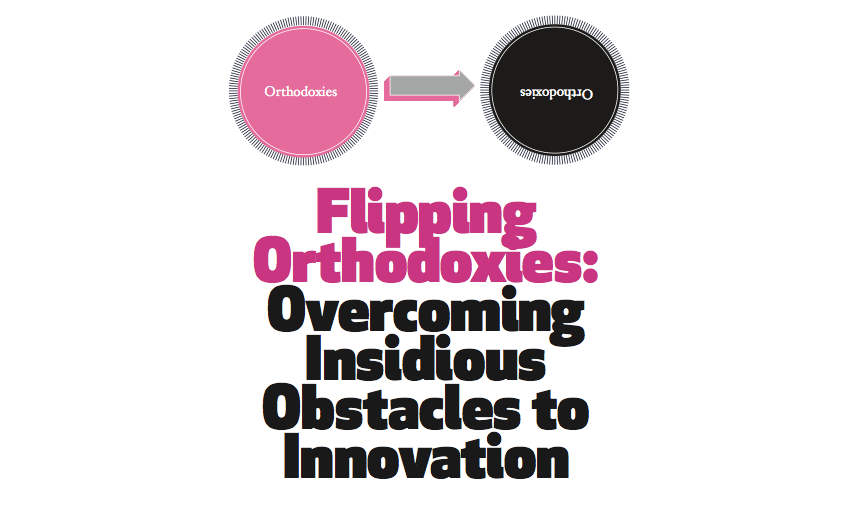
Doblin and Monitor Innovation chief, Bansi Nagji gets top billing this week, for a piece he and I co-authored for Rotman Magazine. Flipping Orthodoxies: Overcoming Insidious Obstacles to Innovation takes a look at those tightly held beliefs that both direct how an organization runs–and often get in its way.

Also this week on Thought You Should See This:

Olafur Eliasson is best known for large-scale art installations. Now he’s responsible for the facade of a new concert hall in Iceland’s capital city, Reykjavik (shown above.) Critics are impressed, while I wondered about Eliasson’s description of “the brutality of clients”–and what that means for other designers.

David Brooks penned a lovely New York Times op ed at how we so often miss the point of what’s really important in life: experiences are important, not things. Praising the piece then led to my being savaged on Twitter.

Email was copyrighted 29 years ago, by the then-16 year old prodigy, V. A. Shiva, who now teaches a wonderful sounding class at MIT.

Cory Doctorow wrote a thunderous piece, Google Plus Forces Us to Discuss Identity, in which he took the search giant to task for following in the footsteps of Facebook.

Video of a British grad student project looking at the potential positive impact smart design might have for those suffering from dementia.

Former Intel chief, Andy Grove sounded off about the state of American manufacturing.

Chipotle produced a beautiful animation spot promoting a sustainable lifestyle (with a Coldplay cover by Willie Nelson.)

Another small design outfit released its ingenious idea for a self-inflating bicycle tire.

Al Lewis wrote a tragicomic piece outlining the borderline insane decisions that Hewlett-Packard leadership has made in the last year.

Investor Fred Destin mulled the fact that premature scaling all too often kills startups stone dead.

[Image c/o Harpa.]

Flipping Orthodoxies: Overcoming Insidious Obstacles to Innovation

Latest word works, for Rotman Magazine. You can see the whole piece (PDF) on Monitor’s site. The abstract is here:

When it comes to innovation, sometimes organizations need to get out of their own way. Orthodoxies, or tightly held beliefs that guide a company’s decisions, can seem as innocent as going along with “the way we do things around here,” or simply following the industry standard regarding the business model and customer experience. However, orthodoxies can be insidious and dangerous to a company’s success, write Monitor’s Bansi Nagji and Helen Walters in the Fall 2011 issue of Rotman Magazine, published by the Rotman School of Management at the University of Toronto.

There are two types of orthodoxies, internal and external. In discussing internal orthodoxies, Nagji and Walters present the case of Ford, whose tight-lipped managerial culture was losing the company billions of dollars a year. This internal orthodoxy was successfully conquered by Alan Mulally, who became Ford’s president and CEO in 2006 and urged managers to give honest reports of the status of their projects. When discussing external orthodoxies, the authors cite companies like Southwest Airlines, which flipped the airline industry model on its head, using one type of jet to cut maintenance costs and flying point to point instead of through major airport hubs.

Nagji and Walters also present five steps to flipping orthodoxies: Be ruthless about finding them; ask “why not?” to challenge preconceived ideas on a regular basis; widen your field of vision by looking in unfamiliar settings to see where orthodoxies have been flipped to learn new ideas; be a credible heretic by acknowledging the orthodoxy’s origins and recognizing the potential ramifications for change; and recognize those who dare to flip orthodoxies.

Finding and overturning orthodoxies is no easy task, however. “There is a fine line between a winning formula and hardwired assumptions that constrain a business,” the authors write. “But through careful assessment and conscious choices, you can discern between self-imposed limitations and the true cornerstones of your enterprise.”

Thought You Should See This, August 26th, 2011

This week’s Thought You Should See This update, for my friends at Doblin:

Steve Jobs gets top billing this week, with the predictable onslaught of premature obituaries greeting his announcement that he would step down as CEO of Apple. Om Malik summed up Jobs’ influence beautifully, saying that the legendarily irascible leader “understands that you don’t walk into the future by looking back. If you do, you trip over yourself and break your nose.

Also this week on Thought You Should See This:

London Business School professor Julian Birkinshaw discusses the difficulty of trying to change how companies actually go about their daily activities, quoting the old adage, “To really understand something, you have to try to change it.”

Jeremy Grantham is the public face of $100 billion asset management firm GMO. And, as head of the Grantham Foundation for the Protection of the Environment, he might just save the world.

New York City’s chief digital officer Rachel Sterne discusses the application of social media in government.

Financial Times writer Gillian Tett takes a look at the influence of behavioral economics on the financial industry and reminds us of the importance of evaluating human behavior when considering systemic issues.

Goodby Silverstein’s Gareth Kay discusses how important it is to get clients to engage on both a functional and emotional level.

Laurie Buczek also offers some smart, common sense advice for those trying to integrate collaborative/Web 2.0 tools into their existing workflow.

Yves Smith writes a provocative piece, Innovate or Die, on the mess we’re in, the reason that government needs to step up to fix things—and why it won’t.

Thought You Should See This, August 19th, 2011

This week’s Thought You Should See This update for my friends at Doblin:

Big props this week to Doblin’s David McGaw, who highlighted a fun story about a brand using Twitter as an easy and quick way to win some good press. Twitter influencer Peter Shankman jokingly asked Morton’s to greet his flight with a steak dinner. A few hours later, the steakhouse did just that. Cue giddy over-excitement and good will all round.

Also this week on Thought You Should See This:

Rotman School of Management dean (and Monitor alum), Roger Martin sounded off about the ratings agencies, in particular S&P. “It drives me nuts that anybody treats the Standard & Poor’s downgrading of the U.S. government’s credit rating with anything but contempt,” he wrote in a sharply worded Reuters op ed.

I spent some time at the Winterhouse Symposium on Design Education and Social Change. The list of attendees is a veritable who’s who of who’s thinking interesting things in this space.

Google bought Motorola Mobility for $12.5 billion. Much punditry and analysis followed. My question: what impact does this have on existing initiatives such as Google Voice, with the bigger question: what effect might the deal have on industry innovation at large?

GM announced that the Cadillac Converj Concept will make it to market, rolling off future production lines as the electric-powered Cadillac ELR.

The Journal runs a profile of Soleio Cuervo, the guy who designed the Facebook ‘like’ icon. I took issue with some of his claims.

Author Lance Hosey wrote about the importance of connecting aesthetics and sustainability. “Aesthetic attraction is not a superficial concern—it’s an environmental imperative.”

Theater critic Christopher Isherwood penned a beautiful review of the dinner theater on display at a particular New York restaurant, capturing the complexity and fantastic importance of seamless, “finely focused” collaboration.

[Image of a porterhouse steak c/o Naotakem on Flickr.]

Thought You Should See This, August 12th, 2011

This week’s Thought You Should See This update for my friends at Doblin:

Much shock and sadness in England, as looters turn out in force to terrorize various city centers. The cause of the riots, despite what premier David Cameron would have us believe, is not Twitter, BBM or social media. It’s decades of active neglect along with a populace encouraged to turn away from anything one might recognize as a moral code and toward self-involved gain and to hell with the rest of you. Way too many links to include in one small round-up (image above from front page of The Times, showing a woman jumping from a burning building in Croydon), but Peter Oborne’s The Moral Decay of Our Society is as Bad at the Top as the Bottom is worth a read, while this Hackney woman’s rant at the tragedy of the small-minded riots is a good reminder that perhaps not all is lost, yet.

Also this week on Thought You Should See This:

File under: worth checking out when you have a spare moment: the New York Times’ new experimental design/development site, Beta 620.

Green Biz’s Joel Makower writes a nice appreciation of Interface’s Ray Anderson, who died earlier this week. The charismatic company founder made a name for the huge strides he took toward creating sustainable business practices in what had previously been an incredibly un-green field.

Some interesting stats on social networking, even though wrapped in one of those irritating, hand-wringy “however will we cope with the overload?” lifestyle type pieces.

In There’s No Such Thing as Big Data, writer Alistair Croll looks at the conundrum facing big businesses looking to innovate. Must-read.

An Ed Ruscha art project from 1965 foreshadows Google Street View by decades.

Hard not to agree with the insight of the XKCD cartoon, Password Strength.

Fascinating chart from Nanex shows that financial “innovation” is alive and kicking on Wall Street.