Thought You Should See This, December 23rd, 2011

Bit of a puny Thought You Should See This update for my pals at Doblin this week, as I’m allegedly on holiday (Mexico!) And not a particularly festive one, either, as I seem to have avoided all the year-end lists like the plague. But I did quite like the round-up from visualizing.org, which shows 2011 in data visualization, and confused me for wondering what Keith Urban had to do with the death of Osama Bin Laden. (Hint: absolutely nothing.)

Still, this week on Thought You Should See This:

Fast Company ran a glowing story about an Indian entrepreneur looking to redesign the sanitary pad. The reporter seemed to unwittingly stumble on the true challenge for would-be disrupters: the behavioral/cultural issues at play.

Mel Exon, founder of BBH Labs, explained why she is sending creatives and strategists to learn more about coding.

Harvard Law professor Larry Lessig gave a simply brilliant presentation at Google, containing a story about the alcoholic captain of the Exxon Valdez that I simply cannot get out of my head. Super important; watch the whole thing if you have a spare hour over the break.

NYT tech writer, David Pogue gave his take on why the leaders of companies including Hewlett-Packard, Netflix and the Flip camera messed up. It boils down to their failure to remember why they’re in business in the first place (to serve customers).

Finally, Hyundai USA is ramping up its design team, having poached Christopher Chapman from BMW to be chief designer at the Hyundai Design Center in Irvine, California. (And I made a snarky comment about the design of the 2011 HCD12 Curb concept car, top.)

So that’s it for 2011. Thanks so much for all your support over the past year, and here’s to a rocking 2012!

Thought You Should See This, December 19th, 2011

Last week’s Thought You Should See This update for my friends at Doblin:

This week, the Stop Online Piracy Act (SOPA) was being weighed by the House of Representatives Judiciary Committee. It’s an important debate that’s got many Internet bigwigs in quite a tizz. Google co-founder, Sergey Brin weighed in (in a post on Google+, natch) while many others are also up in arms.

Venture capitalist and former And 1 executive, Phineas Barnes wrote a smart piece about the questions designers should ask when considering joining a start-up.

Chicago favorite, Scott Wilson launched the LunaTik Touch Pen on Kickstarter, the follow-up to his wildly successful Tik-Tok iPod Nano watch.

Amazon got everyone riled up over a campaign to get shoppers to use bricks and mortar for browsing, its service for buying. Meanwhile, comedian Louis CK streamed a one-hour special show online and pleaded with people not to “torrent” it. (A ploy, it should be noted, that seems to have worked pretty well.)

Google Creative Lab artist, Aaron Koblin launched a personal interactive artwork, sponsored by Progressive. A simple idea, beautifully executed, and an example of the new world of art patronage. (Screengrab shown, top.)

Tech world evangelist, Dave Winer sounded off about Why Apps Are Not The Future.

Tech Review took a look at the inevitable-seeming demise of Kodak and tried to figure out why the company failed to capitalize on technology it was early to develop. An interesting aside: Google is said to be examining Kodak’s assets. Imagine if that played out!

“People who think the Web is killing off serendipity are not using it correctly.” Writer Steven Johnson wrote about his research techniques and discovery process.

The Designer Fund launched a neat interactive piece demonstrating how many successful start-ups have had designers at the helm.

Thought You Should See This, December 12th, 2011

This video has been doing the rounds, and it’s one to savor: rapper Ice Cube waxing lyrically about the improvisational genius of Charles and Ray Eames.

Also last week, on Thought You Should See This:

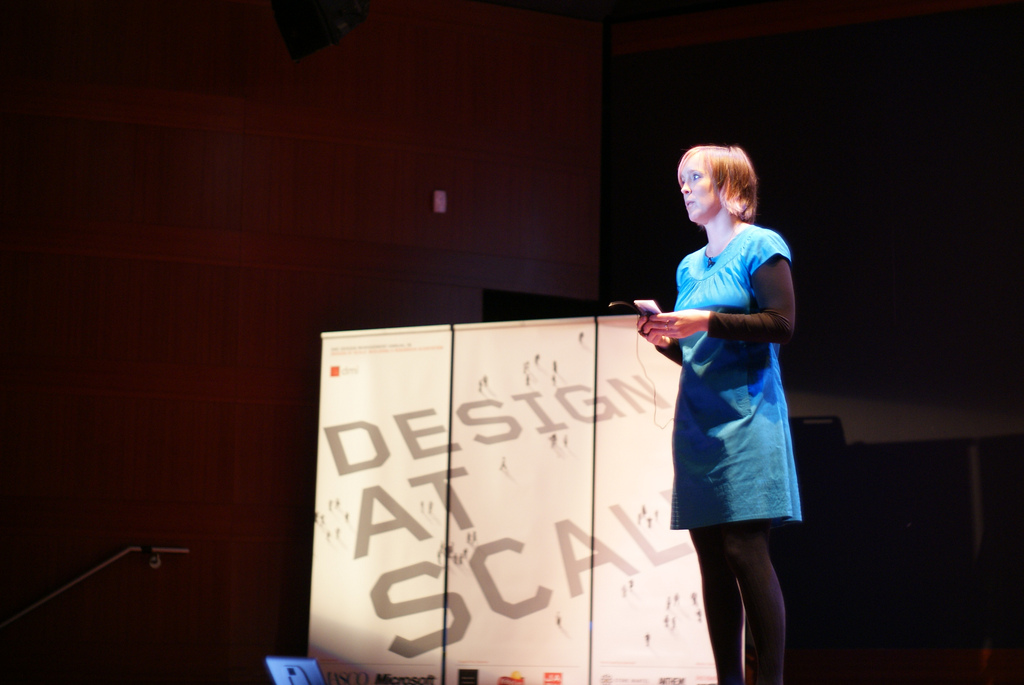
Admire Doblin’s own Brian Quinn and Ryan Pikkel in action. We snagged the rights to stream their presentation from DMI’s Design at Scale. As you can see, they did a great job. Watch–and do send feedback!

Usability design guru, Jakob Nielsen explains why he does not love Amazon’s new Kindle Fire: “You haven’t seen the fat-finger problem in its full glory until you’ve watched users struggle to touch things on the Fire.”

Liddy Manson makes the case for innovation focused on the senior set. As she points out, roughly 13% of the American population is currently over the age of 65, a statistic destined only to grow higher with time.

Urbanized is the new film from Helvetica and Objectified filmmaker, Gary Hustwit. It’s a stylish treatment of an enormously complex–and timely–topic. I jotted down some surprising stats.

Dr Donald Berwick got the pink slip from his job as administrator of Medicare and Medicaid. NYT columnist Joe Nocera looked back at some of his achievements–including his smart approach to management practices.

“Indie capitalism” is becoming a trend. Bruce Nussbaum writes about it at Fast Company, while This American Life ran a wonderful piece about “How to Create a Job.”

Turns out, intense psychological stress tends to shut down the part of the brain responsible for innovative, creative thought. A chilling story about the crash of Air France 447 has lessons for those looking to innovate, too.

Thought You Should See This, December 2nd, 2011

The Clockwork Forest (2011) from greyworld on Vimeo.

Bonanza Thought You Should See This update this week, to make up for the fact I headed back to London during last week’s Thanksgiving holiday. Enjoy!

Al Gore turned up in New York to talk about how gaming can help when it comes to trying to combat climate change.

A former Apple designer turns his design philosophy to a product that’s rather less glamorous than an iPod: a thermostat.

Little Printer” arrives (at least, is announced.) A printer intended to capture peripheral moments generated by social media, it sparked intense attention and, from me, an equal amount of crushing depression.

Some important questions to ask at the start of every project, culled from Michael Porter’s Harvard Business Review piece on creating shared value.

Greyworld creates a project that gets my vote for Most Amazing of the Year: a forest filled with clockwork trees (see video, top).

Frog’s VP of creative, Robert Fabricant, lays out important questions for designers and design firms in the United States to consider, as a matter of some urgency.

Jonathan Hoefler explains the intricacies of the type design process–and why this matters even to those who aren’t type aficionados.

Harvard Law School’s Lawrence Lessig discusses issues of governance and policy in an interview conducted on the publication of his latest book, Republic Lost: How Money Corrupts Congress and a Plan To Stop It.

The Atlantic runs a delightful story about the evolution of the design of the bendy straw.

A departing Twitter engineer flags potential trouble at the social media company.

Veteran autos writer, Phil Patton writes about the Audi Urban Future Summit–and the car as one part of a complex transportation system.

An HBS MBA student outlines why he and his class don’t want to be a part of the so-called “1%”.

An innovative idea in Manhattan proposes the “Lowline” equivalent to the popular High Line public park.

Designer Rob Giampietro shares advice for those starting a studio (his tips apply to entrepreneurs and collaborators of all stripes.)

And finally, British writer George Monbiot rails at the inequity of government and policy in the United Kingdom.

Thought You Should See This, November 18th, 2011

This week, Roger Martin, dean of Rotman School of Management at the University of Toronto, swung by the New York office to talk strategy with Monitor partner, Steve Goldbach. I live-tweeted the affair… and captured the highlights in a blog post on Thought You Should See This. Touching on topics from executive compensation to the philosophy of serving on a board, Martin was thought-provoking and precise, as always.

Also this week on Thought You Should See This:
Jack Dorsey broke down his 80-hour work week, split between his responsibilities at Twitter and Square. Most interesting? That one full day is given over to nurturing the companies and their culture. Impressive.

The Guardian runs a profile of The Horse Whisperer author, Nicholas Evans. It’s astonishing, not simply for its account of the real-life drama that beset the writer and his family after they ate some poisonous mushrooms, but also for his insight into his craft and work.

British designer, researcher and educator Andy Polaine makes a powerful case for the failure of our academic institutions to produce the creative thinkers our future really needs.

Also on an education tip, Greg Matusky looks at the state of higher education through the lens of the Penn State scandal and calls for the bubble to burst.

Former Xerox PARC-er, Anne Balsamo laid out her philosophy of innovation, a welcome contrast with many of the “future of” videos that fail to imagine any kind of interesting future.

Designers “have to do things that a typist with a computer can’t do. This means that they have to be thinkers, problem-solvers, whether they like it or not.” Bob Gill, Pentagram founder and author of Bob Gill: So Far, spells it out.

Is “Stealing Ideas” Really Such a Great Idea? I questioned the trendy meme and failed to answer my own question.

Radiohead artist, Stanley Donwood, released a high resolution, free download of an image to be used by the Occupy protesters (shown, top).

Thought You Should See This, November 11th, 2011

Round-up of this week’s Thought You Should See This posts:

This week, artists Christo and his work and life partner, the late Jeanne-Claude, got the go-ahead for a project they started planning in 1992. They’ll cover over a 5.9 mile stretch of the Arkansas River in southern Colorado with fabric. (Collage 2010, © 2010 Christo, shown.) It promises to be quite something.

Also this week on Thought You Should See This:

Tech world maven, Tim O’Reilly writes about the birth of the collective mind. “Our computers have no intelligence without us, but they accelerate our collective intelligence at a speed that has never been seen before.”

Management expert Jim Collins has a new book out, and in it tells the tale of the “snorkel award“, given by Stryker CEO John Brown to executives who failed to meet his annual challenge of 20% net income growth.

In A Brief Rant on the Future of Interaction Design, Bret Victor goes ballistic over some of those “Future of Technology” videos that have been doing the rounds of late. His problem: that the ideas contained therein are lame. Or, as he puts it: This vision, from an interaction perspective, is not visionary. It’s a timid increment from the status quo, and the status quo, from an interaction perspective, is actually rather terrible.

Stephen Boak of interesting-sounding data visualization platform, Boundary, gave me the inside scoop on the development of the company’s own logo. A great case study on how identity design works in the digital era.

Random video of the week: Onward to the Edge, the latest installment in the Symphony of Science series, auto-tuning insights from the likes of Neil deGrasse Tyson, Brian Cox and Carolyn Porco. Bonkers and amazing.

And finally, artist, illustrator and unapologetic all-round kook, Laurie Rosenwald weighs in on the creative process. “A blank sheet of paper is the devil. People come up with ideas when they’re living life and doing stuff.”

So here’s to living life and doing great stuff all weekend long. Have a good one.

Thought You Should See This, November 4th, 2011

Last week’s Thought You Should See This update for the folks at Doblin:

More from the Design at Scale conference this week, with a recap of Brian Quinn and Ryan Pikkel’s storming presentation of the refreshed version of the Ten Types of Innovation. I particularly enjoyed their stern reminder that good design alone doesn’t guarantee success, with nods to the Flip camera and Amazon Kindle. Useful and enlightening. They really did a great job.

Also this week on Thought You Should See This:

Roo Rogers, president of Red Scout Ventures, and Cameron Tonkinwise, associate dean for sustainability at Parsons, discussed the importance of design in a “sharing economy.”

Knoll CEO Andrew Cogan chatted with Cooper-Hewitt National Design Museum director, Bill Moggridge about the challenges of running a design-based business.

Christopher Robbins showed off his public art pieces, including his work as part of the Ghana Think Tank collective. Truly provoking and inspiring ideas here.

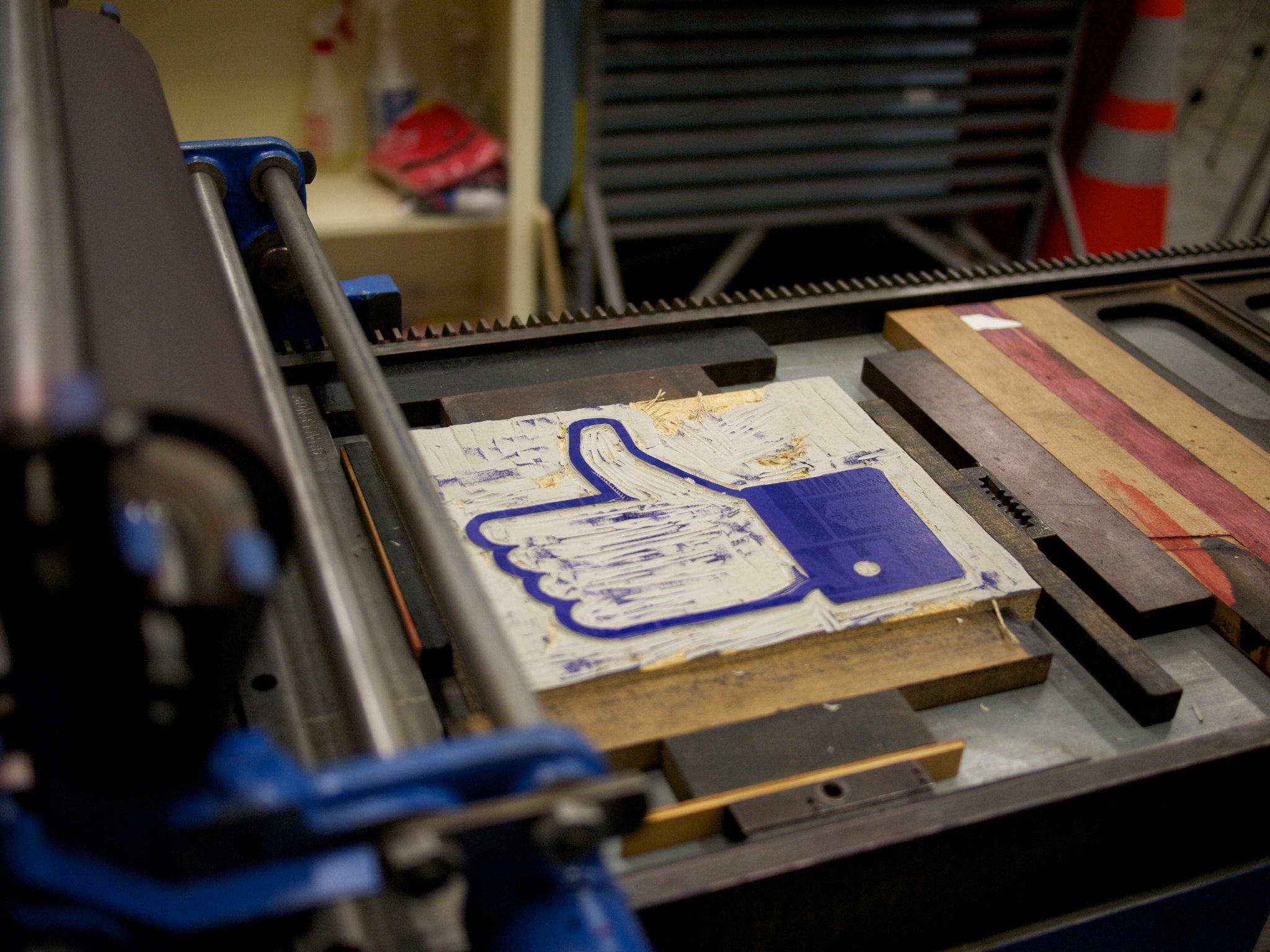
Facebook designer Everett Katigbak gave an insight into the company’s culture by showing off the “analog research lab”. That’s a fancy name for a print studio, which he and a colleague started just because they could. (“Like” icon as lino print shown, above.)

Mayo Clinic Center for Innovation design manager Lorna Ross shared 20 Ways to Protect and Nurture Design.

“If it was unprecedented, I’d be pretty sure we were doing something wrong.” Great reminder of the importance of research and history from materials science professor, Debbie Chachra, who was describing how she conducted research into the mysterious structure of a cellophane-like material made by bees to protect their eggs. After exhaustive research, it turned out to be protein, not polyester, and not so mysterious after all.

One from left field: Origamibiro shared a lovely video meshing audio, visual and meaning.

And, finally, one for graphic design buffs: PHARMA is an exhibition of mid-20th century graphic design and advertising created on behalf of the then nascent industry.

Thought You Should See This, October 28th, 2011

Thought You Should See This update for my friends at Doblin:

This week, my time was mostly taken up with the “Design at Scale” conference, of which I was the co-chair. Some highlights:

Local Projects‘ Jake Barton spoke of the importance of prototyping as a collaborative, improvisational process.

Edible Geography blog writer and Foodprint Project co-founder, Nicola Twilley talked of “food as a design tool“, and showed some wonderful projects of people thinking about or using food in interesting or unexpected ways.

General Electric CMO (and event co-chair) Beth Comstock outlined the importance of design to business (and vice versa).

Pentagram partner Michael Bierut entertainingly detailed seven things he loves about design.

Todd Blumenthal and Beverly House, Aeropostale’s head of merchandising and head of design, gave an insight into their relationship–and how they manage a process that sees the production of 15,000 SKUs every year.

Brian Collins gave an informative behind-the-scenes look at his life as a designer behind advertising lines, concluding with a useful set of principles we would all do well to remember.

Also this week on Thought You Should See This:

Analysts are turning on Groupon, even as the coupon giant gears up for a November IPO.

Steve Wozniak wisdom: “Every problem has a better solution when you start thinking about it differently.”

And, Design With the Other 90%: Cities has opened at the United Nations. The New York Times’ new architecture critic, Michael Kimmelman, declared it a hit.

[Photograph of me looking very serious at Design at Scale c/o DMI.]

Thought You Should See This, October 21st, 2011

This week’s Thought You Should See This update for my friends at Doblin:

Our beloved leader, Doblin president Larry Keeley gets top billing this week, for a great speech he gave at TEDx Academy, in Greece. Along with poking fun at American economists, Larry laid out the most interesting opportunities in innovation right now, including the important idea of using adversity as inspiration.

Dilbert takes on forecasting and scenario planning. Ouch.

Google engineer Steve Yegge went on an incredible rant about platform innovation, and how his employer doesn’t get what it’s doing when it comes to social.

The ULTra transport system consists of 21 electric vehicles running on a four kilometer elevated guideway linking London Heathrow’s Terminal 5 and two stations in the business parking lot. It’s the first commercial Personal Rapid Transport (PRT) system in the world. Also in this Guardian article are some other useful examples of transport innovation.

Ever think about “scraping the barnacles” off your work? You should.

Two fabulous videos to marvel at: a crazy demo of quantum levitation and two robots playing ping pong.

Faculty members of the School of Visual Arts’ new graduate course, Products of Design, opine on what’s interesting them in design these days. I pop up to blather on.

And finally, a heart and stomach-warming Facebook marketing campaign from Heinz in the UK, offering the chance to send a can of soup with a customized get well soon message to a sick friend. (Dummy label, top.) Smart and sweet.

Thought You Should See This, September 30th, 2011

Lots of breathless excitement and hoopla this week over Amazon’s introduction of a new series of Kindles. Of particular note was a post by longtime Apple employee about what this means for Facebook and, particularly, Google. “This,” wrote Chris Espinosa, “is the first shot in the new war for replacing the Internet with a privatized merchant data-aggregation network.” Gulp.

Also this week on Thought You Should See This:

Behavioral economist Dan Ariely warns of the dangers of creating a “complete contract” with employees, ie, being too specific about who must do what, when. Instead, he advises, build a culture in which employees actually buy into your company’s broad objectives.

The New Yorker‘s architecture critic, Paul Goldberger, weighs in on the proposals for Apple’s new HQ design, and he’s not exactly a fan. “It may not be entirely fair to expect [Apple] to conquer suburban sprawl,” he writes of the circular building. “But you would hope that a forward-thinking company would at least try not to compound the problem.”

The Journal runs an excellent look at the innovation process at H. J. Heinz, where executives just spent the past three years developing a new tomato ketchup sachet (top).

Method’s founders write of the value of “soft innovation.” “Appropriating ideas from another category is about being inspired and translating someone else’s innovation to a new purpose.”

More thoughts on the tech innovation cycle and the mirage of net neutrality, c/o tech world veteran Dave Winer and author Douglas Rushkoff.

And finally, musings on Facebook’s “frictionless sharing” from The Atlantic, along with an eye-opening chart from Nielsen detailing the state of social media. (The full report has lots of stats and useful visualizations.)