The Artist is Present. Ish.

Seems like this summer is the age of the artist deigning to grace their public with their presence for more than just the private view. Ish. Continuing a theme I touched upon last year after seeing Antony Gormley’s “One and Other” exhibit, in which the artist handed over the empty plinth in Trafalgar Square in London to successive members of the British public to do with it what they liked, a couple of shows in New York this summer are similarly inclusive.

Marina Abramovic, for example, was heroic at MOMA, turning up from open to close every day from March 14 through May 31 to stare off a motley crew of assailants who included the moved, the confused, the uber-fans and, of course, the slew of celebs you might expect in Manhattan. Those attendees were the attention-grabbing but easily the least interesting thing about the piece, which culminated in a reunion between Marina and her former partner-in-life-art-love-hate-crime, Ulay. I was in France for the finale (for my brother’s wedding, which was a lovely and happy time so I can’t regret not being there, though I’d have loved to have beamed in for this moment) and so missed the former couple’s reunion, but I imagine it was impossibly moving. You couldn’t look at their work in the galleries upstairs and fail to be affected  by their fanatical sincerity and commitment to pushing any boundary they could imagine. It’s not a question of loving every moment of their work–I fair ’nuff ran through the gallery that showed video of Marina screaming herself hoarse, which I couldn’t handle at all. But the fact that she was sitting just a few floors below added to the pathos and impact of the whole.

Arguably less (self-) obsessive, but no less thought-provoking, is the current exhibit of Christian Marclay’s work at the Whitney. I’ve been familiar with Marclay’s work for some time, ever since my friend Jane excitedly dragged me to see a showing of his amazing sound/video piece, Video Quartet, which sadly isn’t on show here. But there’s much to admire. Marclay is a so-called turntablist who relishes in shattering expectations and  boundaries.

I settled down to watch a presentation of some of his older video work, including a piece called “Record Players”. The first shots show someone eagerly ripping open a new LP from its cellophane wrapper. He or she gingerly holds the vinyl in his/her hands… and then immediately scratches it violently. I literally gasped. It totally played with my expectations (I grew up believing in the sacrosanct nature of vinyl, and this was an unexpected, violent, totally shocking act.) The rest of the film shows a group of merrymakers defiling vinyl any way they can, music and rhythm coming from their actions. Towards the end, they take turns in breaking their discs and then stamping on them. Again, the noise is the soundtrack. It might sound a bit unlikely, but it’s intriguing and quite amazing.

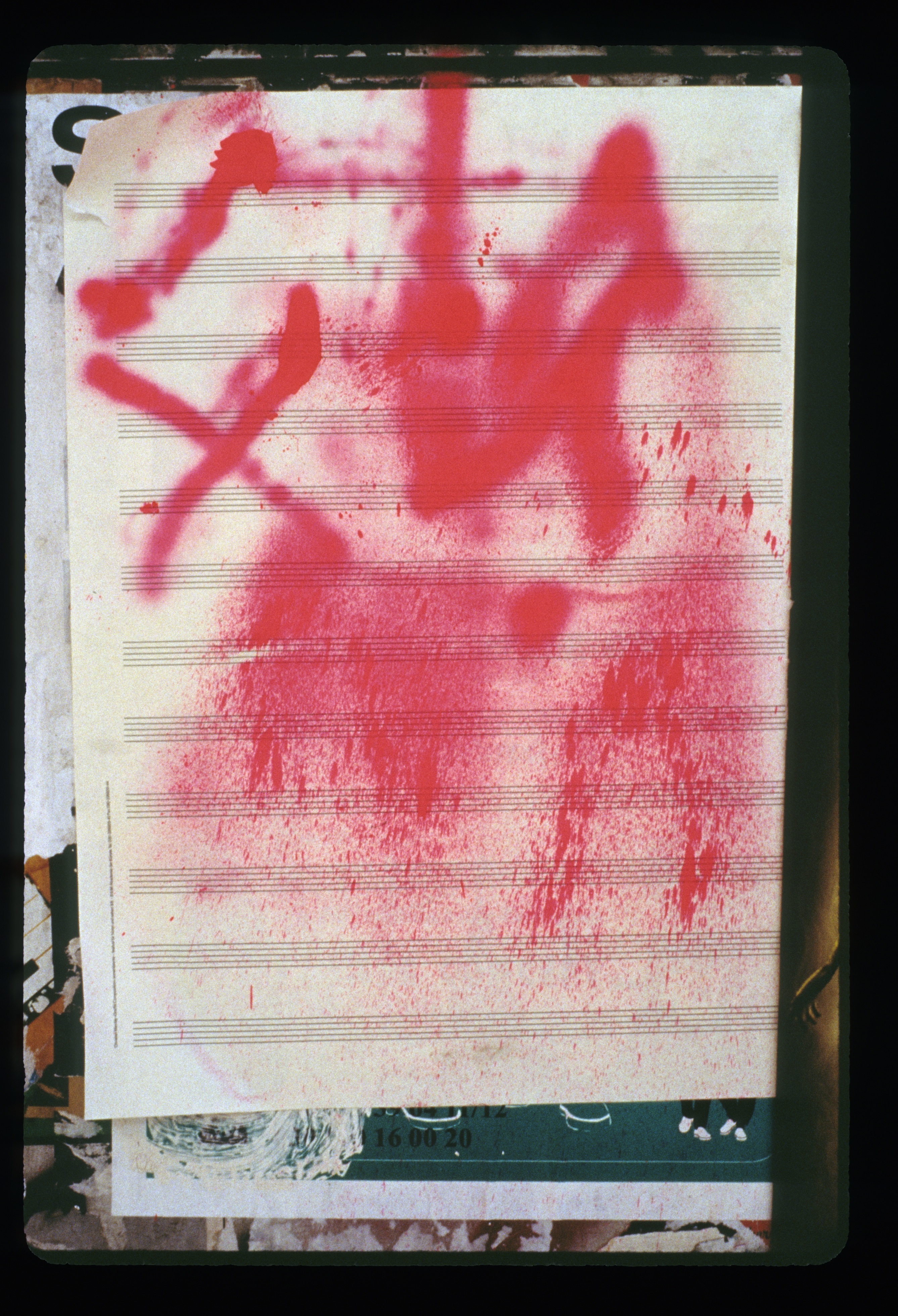
Marclay is also interested in his audience. At the show here, one wall has been converted into a huge chalkboard, complete with musical staves. Attendees are encouraged to daub thoughts and notes (music and text). Another installation (image shown, top) is Marclay’s piece, Graffiti Composition, a seven year project in which the artist stuck up blank sheet music around Berlin, collecting it after it had been added to by locals. Now these images are used as scores for musicians to interpret, in performances that will take place throughout the duration of the show.

Honestly, I’m not sure what all this means apart from that remembering to be mindful that other people can have good, useful ideas too is a critical skillset we’d all do well to remember and develop more. For successful innovation to happen, alternative points of view have to be heard. That might happen by giving power to the public (Gormley) or it might occur by throwing yourself on your community (Abramovic). Alternatively, you might prefer to curate your audience (Marclay). All tactics have their merits. All are brave, deserve our applause–and have wider applications outside of the museum and in the world at large.

Image: Christian Marclay, Graffiti Composition, 1996–2002. Portfolio of 150 digital prints. Printed by Muse X Editions, Los Angeles, published by Paula Cooper Gallery, New York. Courtesy the artist and Paula Cooper Gallery. © Christian Marclay
No Pollution Not Any

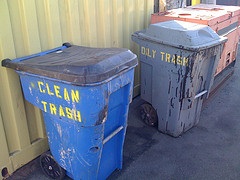
I took these two pictures in 2009, when I went on a tour of the Long Beach oil islands before that year’s TED conference. The four man-made islands sit right off the shore and were once the focal point for what used to be known as THUMS (Texaco, Humble, Union, Mobil and Shell’s joint effort to develop and produce oil from underneath Long Beach.) Now owned by Occidental Petroleum, the plant consists of 1500 wells, whose tentacles stretch underneath the California mainland.

At the time, I mainly loved these images for their retro graphic quality (You can read my original BusinessWeek blog post about the tour here.) Now, the recent, awful events in the Gulf of Mexico lend them a more ominous tone. “No Pollution Not Any”? We wish.

The Modern Corporation: It’s About People, People

As turmoil continues to roil economies both large and small, as politicians struggle to figure out how to deal with the conditions of the 21st century, and as the United States and the West heads into what Paul Krugman describes as no less than “The Third Depression”, a new way of thinking about management and innovation is making the rounds.

It’s about people, people. Instead of thinking about the corporation as an amorphous entity, executives need to remember the individuals at the heart of every organization. Ok, so it’s not exactly an earth-shattering insight, but it’s a sign of how far we’ve drifted that people’s health, hopes, insights, and talents have come to be seen as mere grist for the grinding wheels of capitalism.

Three moments emphasized this shift for me recently:

1. John Hagel, co-author of the recent, highly recommended book The Power of Pull: How Small Moves, Smartly Made Can Set Big Things in Motion, talks about the “red queen effect”, where executives are running faster and faster to stay in the same place. The problem is, they’ve essentially already lost this particular race, and trying the same old techniques only means they’ll fall further behind.

Now, says Hagel, is precisely the time for executives to figure out what, precisely, their firm is really about. And while Ronald Coase may have won the Nobel Prize in 1991 for his theories of efficiency within the industrial organization, executive focus in 2010 has to be on talent development. Not, says Hagel, simply a cursory nod toward human resources but a concerted effort toward making a focus on talent integral to every part of an organization.

2. At the recent New York Forum, I sat in on a breakout session about how large corporations should handle the challenge of disruptive innovation. Truthfully, there wasn’t much consensus; it mainly seemed like an opportunity for panelists to trumpet their fervent support for and dedication to the discipline of innovation, the definition of which was unclear. But Glenn Kelman, CEO of online real estate company (and would-be industry disruptor) Redfin, had some insights that have stuck with me. “The number one thought I have every day is how do I make Redfin the best place to work for engineers,” he said. “One great engineer is worth 10 mediocre engineers. And a great engineer won’t work somewhere that engineering isn’t valued.” For Kelman, the future, intuitively, lies with people. Make them happy; watch your company thrive.

3. I’ve recently been reading The Power of Positive Deviance: How Unlikely Innovators Solve the World’s Toughest Problems. I’ve written about PD before; it’s a curious philosophy of examining the behavior of outliers to see how they’ve intuited a better way of doing something than ‘most everyone else in their same society. The most frequently cited example of PD in action comes from two of this book’s co-authors, Jerry and Monique Sternin, who documented it in action while working for Save the Children in Vietnam. By looking at what a few individual parents did with the same resources in the same situation as an entire community (in this instance resulting in healthier children), positive steps for all could be identified—and rolled out for the wider benefit of the inhabitants.

But PD isn’t limited to developing markets, and the authors include some potent examples from business, too, including from within giants such as Merck and, believe it or not, Goldman Sachs. The former company tried PD as a last resort in Mexico, where it brought about the resurrection of sales of the drug Fosamax, a miracle osteoporosis drug that reps had nonetheless struggled to sell. Manager Andres Bruzual called his district managers for a meeting, outlined the principles of PD and told them to have at it. As the book’s other co-author, Richard Pascale, outlined to me on the phone: the managers were initially both skeptical and horrified. But once they realized that the onus really was on them to figure out the next, best steps, they rose to the challenge. By allowing individuals to feel like they had some say in how they should best do their job, Merck Mexico pulled off a seemingly impossible success story.

In an age where people can work anywhere, on anything, and for a generation that hasn’t grown up with the promise of a job for life (and is probably horrified at the very idea of it), the real challenge is for the corporate supertankers of our time to prove they can turn away from the very real threat of being out-maneuvered on all sides. Thoughts on which companies might prove the Titanics of the age? Or which behemoths have the chops and the wherewithal to adapt in time?

This post was originally published on the NEXT blog at Bloomberg Businessweek.

Rupert Murdoch Opens New York Forum, Declares Love For iPad

Rupert Murdoch was on fine, ornery form at the opening plenary session of the New York Forum, an event aimed at bringing together CEOs, policy makers and thought leaders in a bid “to reinvigorate the economy”. Organized by Richard Attias, who produced the World Economic Forum in Davos for some 15 years, the main event kicks off tomorrow at the Hyatt Hotel, near Grand Central station. Tonight saw a panel discussion featuring Hearst Magazines president Cathy Black, Philippe Camus, chairman of Alcatel-Lucent and Tishman Speyer CEO, Jerry Speyer.

Murdoch was frank about the disarray within the media industry, though he declared himself optimistic at the pace of innovation that’s occurring in response to the disruption. He was also somewhat effusive in his love for Apple’s iPad. “This is a fantastic invention,” he said. “It combines the ability to present all forms of media to all people, from three year old children to 100 year old men.” He added: “I believe that within five years, you’ll have many hundreds of millions of iPad or iPad-like devices in the world. This is a huge new market.”

Along with reiterating his widely-stated belief that publishers made a huge mistake in making digital content free of charge, Murdoch also took a swipe at President Obama, describing him as “too aloof” and criticizing his politics as a lot more “left of center” than those who voted him in had perhaps realized. So what, asked moderator Maria Bartiromo, should Obama be doing to get the U.S. back on track? “I think he should be going in the reverse direction,” said Murdoch. “You won’t get this country right until you have less government and less taxes.” Unless Obama changes direction, he said, the United States should brace itself for another two and a half years of “at best no growth”.

Other policies also came in for some Murdoch opprobrium, including his disdain for the healthcare bill, and his call for better support of entrepreneurs and small businesses, which will, he said, provide the only way out of the recession. As for immigration, he said, current policy is “an absolute scandal”.

“We educate people and then we give them a ticket home,” he said, echoing the likes of Y Combinator co-founder Paul Graham, who proposed the Founders Visa program to promote startup investors in the U.S. “The best brains, who’d love to settle here and start businesses, go through our great universities, and then we say ‘sorry, you can’t have a green card’,” said Murdoch. He shook his head before launching into another tirade, this one about the state of the education system. “Our inner city education is a disgrace,” he said. “In Los Angeles, people talk about ‘dual language education.’ They’re turning out illiterate people in both English and Spanish.”

Final jab of the night went to the “greenies”, as Murdoch declared himself a skeptic on climate change before outlining his support for running natural gas pipelines through Alaska. The strategy could save the United States $150 billion a year, he mused. And anyway, “We didn’t buy Alaska to look after the moose.” One final politically incorrect opinion that nonetheless got a big laugh from the audience.

Image (c) Diane Bondareff

This post was originally published on the NEXT blog at Bloomberg Businessweek.

Stephen Doyle Wins National Design Award

Bill Moggridge, co-founder of IDEO and the newish director of the Cooper-Hewitt museum in New York this morning announced the winners of the 11th annual National Design Awards. The honorees form an eclectic list, with prizes given to representatives from fields including interaction (Pentagram’s Lisa Strausfeld), architecture (Philadelphia firm, KieranTimberlake), and product design (Smart Design).

The “Design Mind” gong for someone who has “affected a shift in design thinking or practice through writing, research and scholarship” went to Ralph Caplan, former editor of I.D. magazine (RIP) whose book By Design: Why There Are No Locks on the Bathroom Doors in the Hotel Louis XIV is a must-read for all those wanting to wrap their heads around the sometimes opaque and confusing discipline of design. His 1982 book, updated in 2004, contains pithy soundbites by the bucketload, including my long-time favorite: “while design by committee represents a solemn commitment to mediocrity, design by collaboration is simply the way the world works, usually for the better.”

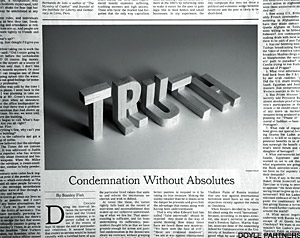
Stephen Doyle, who picked up this year’s award for communications design, has a similarly trenchant take on design by committee. For Doyle, who regularly works on projects for mega-clients such as Barnes & Noble and Martha Stewart as well as smaller commissions such as illustrations for the NYT op ed page (shown), the key is in access to the C-suite. “Good design starts at the top. You have to work for the boss,” he said when I called to congratulate him this morning. “You can’t make headway against a bunch of middle managers who are trying to cover their asses when reviewing design work. Everyone wants to not fail, so things will get diluted on the way up. ”

Doyle, who proudly told me that he’s been at the helm of a design studio in New York City for “25 years and one week”, added: “When you deal with the leader they’re so much less afraid of failure because they’re responsible for success.” That’s an attitude that anyone involved in commissioning or reviewing projects of any type—not just design—would do well to bear in mind.

Here, take a look at the full list of this year’s winners and runners up. Congratulations to all.

This post was originally published on the NEXT blog at Bloomberg Businessweek.